These are the real questions I get from Central Texas landowners — straight answers, the way I'd give them standing on your property. If yours isn't here, call or text 737-235-1335 and I'll tell you straight.
Will my cedar grow back after you clear it?
No — and this surprises most people. Ashe juniper (what we call cedar) doesn't resprout from a cut stump. When we mulch or cut it below the lowest green growth, that tree is dead and the roots die off — the stump you cleared today won't grow back into a tree. What can happen is new cedar coming up from seed over the years, since mature trees drop a lot of berries. But that's slow, and a periodic touch-up keeps it in check. (More in our guide to slowing cedar regrowth.)
What about mesquite? Will that grow back?
Yes — and I'll be straight with you, because this is where a lot of folks get burned. Mesquite is the opposite of cedar. If we only cut or mulch the top, it comes right back from the root, often thicker than before — cut one and you can get two. That taproot runs deep. So if you want mesquite gone for good, mulching the top alone won't do it; the root has to be grubbed out or treated. I'd rather tell you that up front than have you call me in a year wondering why it's back. (Full detail on our mesquite guide.)
Isn't it easier and cheaper to just burn it?
Not usually, once you add it all up. Burning means cutting, piling, waiting for the right conditions, and hoping a burn ban isn't in effect — and in Central Texas, burn bans are common in the dry months, which can stall your project for weeks. You've also got smoke, neighbor complaints, a fire risk you're liable for, and a burn scar left in your yard. Mulching happens in one pass, any time of year, ban or no ban, and the material stays on the ground as mulch instead of going up in smoke. For most properties it ends up faster, safer, and about the same or less. (Here are the hidden hazards of burning brush.)
Why are mesquite trees such a problem?
Mesquite is one of the toughest, most stubborn trees in Texas. That taproot can go down 20 feet or more, which is why it survives droughts that kill other trees — and why it's so hard to get rid of permanently. It spreads fast (livestock and wildlife carry the seeds), the thorns are brutal on people, pets, and tires, and it steals water and space from your grass and better trees. It's a fine shade tree if you want it, and the wood's great for smoking meat — but on land you're trying to use, it's usually a nuisance. The key thing to know: killing the top doesn't kill mesquite. Real control means getting the root.
What does the ground look like after mulching?
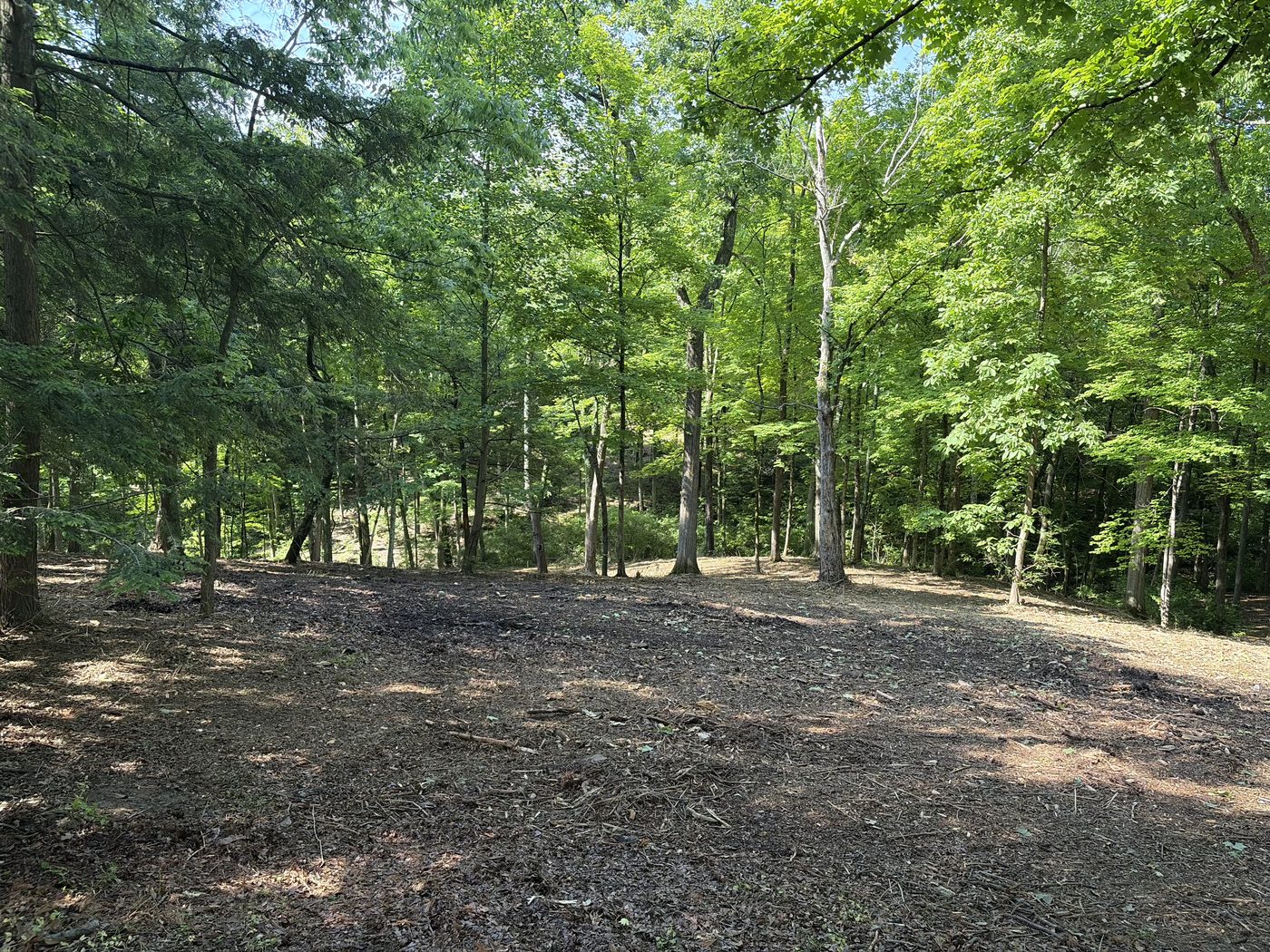
You're left with a layer of fine wood mulch spread evenly across the ground, usually a couple inches deep — like a fresh landscaped mulch bed, but spread out instead of piled. No stumps sticking up, no holes, no burn scars, no piles to deal with. You can walk it, mow it, drive on it, run cattle on it. Over the next several months the mulch breaks down and feeds your soil.
Does the mulch hurt my land, or is it good for it?
It's good for it. The mulch layer acts like a blanket — it holds your soil in place so it doesn't wash out in the first hard rain, holds moisture during the dry stretches, and slows the weeds and brush that would otherwise pop right back through bare dirt. As it breaks down it puts nutrients back into the ground. Bare dirt after a clearing job erodes and grows weeds; a mulched surface protects and feeds the land. (More on what mulching does to your soil.)
Will clearing help my grass and my good trees?
Usually, yes. Cedar and mesquite both compete hard for water and sunlight — a mature cedar can transpire roughly 33 gallons a day, and dense brush chokes out your grass and crowds your oaks and elms. Thinning the junk out frees up water, light, and space for the trees and pasture you actually want. We clear selectively — take out the cedar and brush while leaving your good hardwoods standing. (See cedar and your water table.)
How big of trees can you handle?
Our machine handles brush, saplings, and trees up to roughly 6 to 8 inches across, depending on the species and how hard the wood is. That covers the vast majority of cedar, mesquite, and overgrowth on most properties. If you've got bigger hardwoods mixed in, I'll tell you at the walkthrough whether it's a fit or whether those need a different approach — I won't force the machine onto something it's not built for.
Is forestry mulching better than a dozer?
For most overgrown-land jobs, yes. A dozer scrapes everything down to bare, compacted dirt — and it takes your topsoil with it, the precious top layer that took decades to build and that your grass depends on. It also leaves you piles to haul or burn. Mulching keeps that topsoil in place under a protective mulch layer, with nothing to haul. A dozer earns its place when you need clean, graded dirt to build on — and I'll tell you honestly which your job actually needs. (Land clearing vs. mulching.)
Do you spray herbicide?
No — we're a mechanical outfit: mulching, clearing, grubbing, and stump grinding. On something like mesquite where a chemical follow-up makes sense, that's a separate step you or a licensed applicator handles, and I'll tell you straight when a job needs it.
Do I need a permit to clear my own land?
Most rural residential clearing in this area doesn't require a permit, but it depends on your specific location, whether there's a floodplain or wetland involved, and your county or HOA rules. I'll flag anything I see during the walkthrough, but the final word is with your county — and I'll always point you to check rather than guess. (More in do you need a permit to clear land in Texas?)
Do I have to haul off the debris or burn anything?
No. That's the whole point of mulching — the trees and brush get ground up and stay right there on the ground as mulch. No hauling, no dump fees, no burn permits, no piles. One machine, one pass, and you're left with usable ground.
How long does it take?
Depends on the size and how thick it is, but mulching is fast compared to the old cut-pile-burn or dozer-and-haul methods, because it's all one pass. Many residential and small-acreage jobs are a single day. When I walk your property I'll give you a straight timeline for your specific place. (Roughly half an acre to two acres a day, depending on the ground.)
Can you clear right up to my fence line, house, or trees I want to keep?
Yes — that's one of the things the machine does well. We can run a clean corridor along a fence line, clear around structures, and work selectively around the trees you want to keep. Just mark or point out anything you want left standing and we'll work around it. On borderline trees near a property line, I'll walk it with you before I take anything down so nothing comes out that you wanted kept.
Can I stay on the property while you work? Is it safe?
The machine throws material and moves fast, so I'll keep you back a safe distance while it's running — but you're welcome to be there. Honestly, I like walking the property with you before and after so we're on the same page about what's coming out and how it turned out.
What time of year can you mulch?
Any time — mulching works year-round, which is one of its biggest advantages over burning, since burn bans shut that down in the dry season. There's no reason to wait on a season if your land needs clearing now. (More on timing your clearing.)
What does it cost?
Forestry mulching runs roughly $1,500 to $6,000 an acre depending on how thick and how big the growth is; other work is quoted by the job. It's a guide until I see your place, and a minimum job price applies. Full breakdown on our pricing guide.
Still have a question? Call or text 737-235-1335, or see our pricing guide and Learning Center.