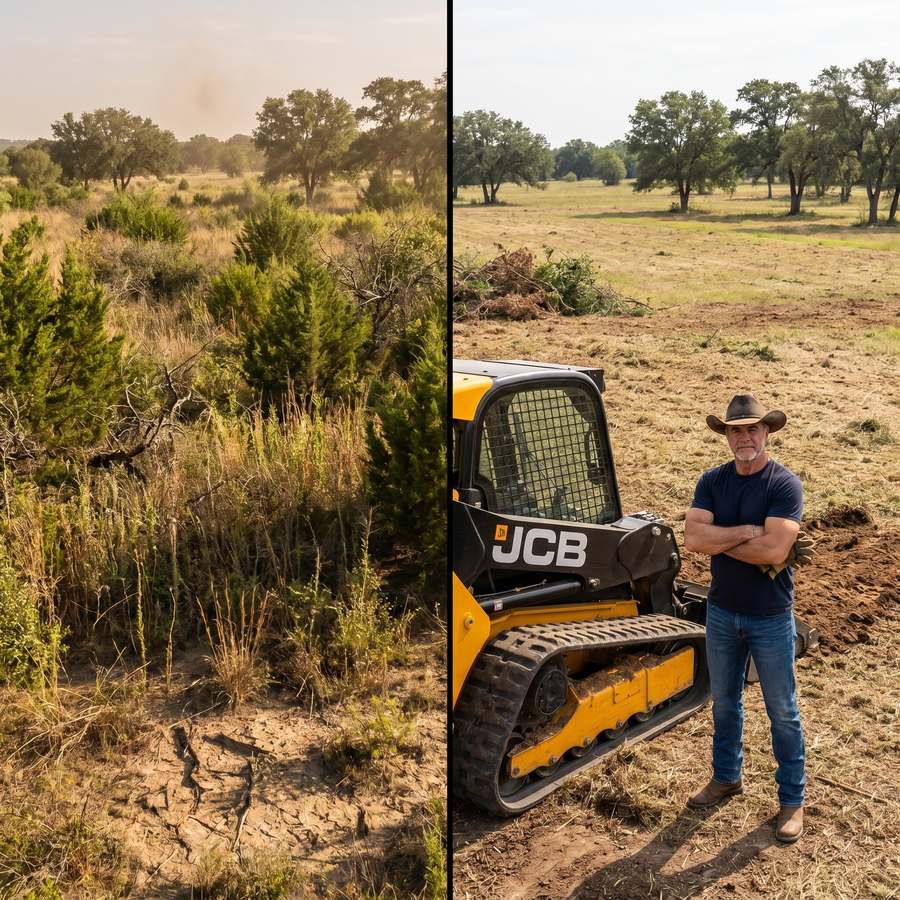
Mesquite is one of the toughest brush problems in Central Texas because it fights back from underground. Cut it or mow it and it resprouts thicker from a bud zone 12 to 18 inches below the soil. The only way to truly kill it mechanically is to remove that root crown — which is why grubbing, not just mowing, is what actually works.
Will Mesquite Grow Back After You Mulch or Cut It?
Yes — and usually thicker. Mesquite carries a specialized crown of dormant buds 12 to 18 inches below ground. When you cut, mow, or mulch off the top and leave that crown in place, those buds flush and a single-trunk tree comes back as a multi-stemmed bush. That's the number-one thing landowners get wrong: knocking mesquite down without dealing with the root crown doesn't clear it, it multiplies it.
Why Mesquite Is So Hard to Kill
Everything about this tree is built for survival in dry country. Its taproot can reach 40 to 150 feet down to the water table, so drought barely fazes it. A dense mat of lateral roots spreads well past the canopy in the top three feet of soil, soaking up surface moisture before your grass ever gets a drink. It's a legume, so it fixes its own nitrogen and doesn't need rich ground. And its seeds have hard coats that survive being eaten — cattle and wildlife spread pre-fertilized seed across your pasture, so it keeps coming from the seed bank for years.
Is Mesquite All Bad?
No — at controlled densities it earns its keep, which is why total eradication usually isn't the goal. The bean pods run 11 to 17 percent protein and feed cattle, deer, and quail in late summer. The wood is prized for furniture and for barbecue smoke. It fixes nitrogen and, in sparse cover, shades and builds soil. A smart plan keeps roughly 10 to 20 percent selective cover — healthy single-trunk mesquites along fence lines and draws for shade and wildlife — while clearing it out of your working pasture.
What It Does to Your Pasture and Water
Left to spread, mesquite shades out and starves your good native grasses, replacing them with weeds or bare dirt. A heavy stand acts like a bank of groundwater pumps, pulling down soil moisture and your local water table. And the one- to two-inch thorns are a real hazard — flat tires on your equipment and eye and hide injuries to livestock. On rangeland you're trying to graze, dense mesquite is a direct hit to how many acres actually work for you.
How CHEW Clears Mesquite
We handle mesquite mechanically — no spraying. There are two ways we go at it, and the right one depends on your density and your goal:
Forestry mulching grinds standing mesquite and mixed brush into ground cover fast, opening the land back up in a single pass. It's the quickest way to reclaim overgrown acreage and it leaves a soil-protecting mulch layer. The honest caveat: because it leaves the root crown, expect resprouting — mulching alone is a reset, not a kill, so it works best paired with follow-up.
Grubbing is how you actually kill it. Using a skid steer with a grubbing attachment, we pop the whole tree and its root crown out from 12 to 14 inches down. Done right on low-to-medium density, that's near-total root kill — the tree doesn't come back. For heavier work we also grind the leftover stumps low. (See our stump grinding and land clearing services.)
Where a chemical follow-up makes sense — treating the resprouts after a mulch job, for instance — that's a separate step handled by you or a licensed applicator. We'll tell you straight when a job needs it, but we don't spray.
A Realistic Mesquite Plan
Lasting control is a plan, not a single pass. Keep 10 to 20 percent of your healthiest single-trunk mesquites for shade and wildlife. Clear the pasture by grubbing where you want it gone for good, or mulch-and-follow-up where speed matters. Then monitor — seedlings will keep germinating from the seed bank for 5 to 10 years, so a yearly walk-through to catch the young ones keeps you ahead of it. Manage your grazing too: thick native grass is the best defense against new mesquite getting established.
Not sure how heavy your stand is or which approach fits? Send a few photos and we'll tell you what it'll take — and roughly what it runs on our pricing guide.