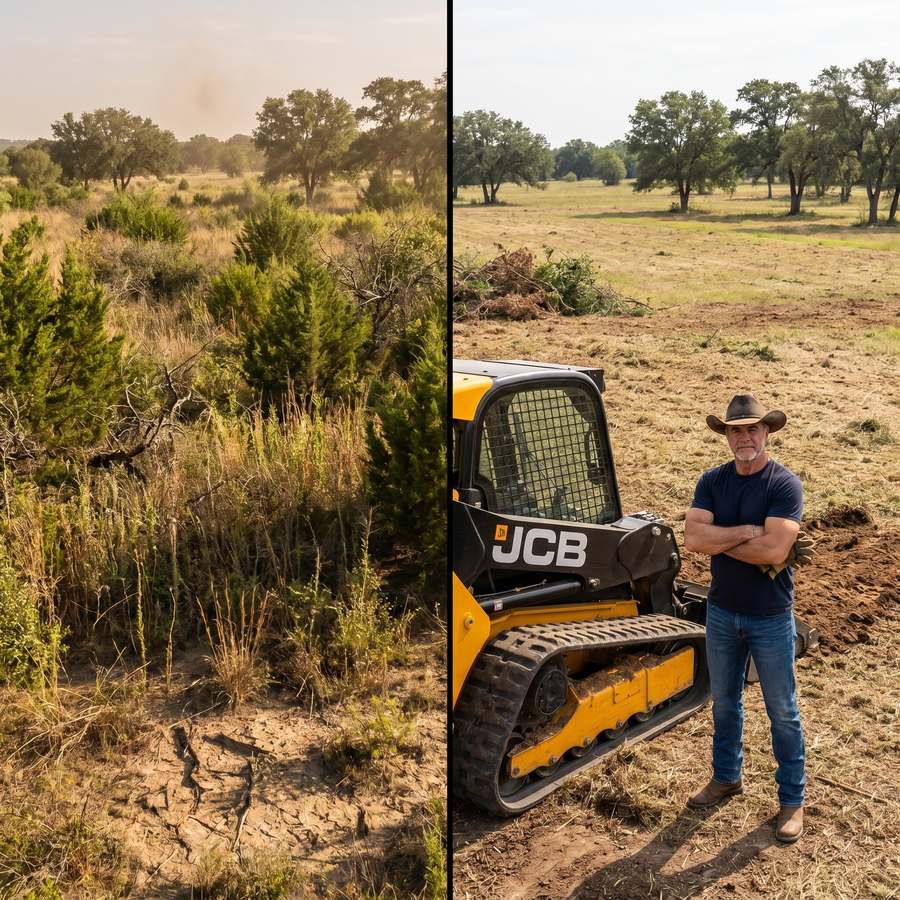
You can tell forestry mulching will work by checking three things first: tree size (best under 10 inches), rock (limestone and caliche disqualify it), and vegetation type (resprouters like Yaupon holly need follow-up herbicide). A thorough site assessment is the single most reliable predictor of success.
If you're a Central Texas contractor considering forestry mulching for your next clearing project, one critical mistake can turn a cost-effective solution into an expensive do-over. Rocky terrain and one specific plant species are deal-breakers most don't see coming. Here's how to read a site — and the results — before and after the machine rolls in.
Key takeaways
- Forestry mulching works best on trees under 10 inches in diameter — efficiency drops off fast above that.
- A properly mulched site leaves a 2–6 inch organic layer that suppresses erosion, holds moisture, and rebuilds soil over 1–3 years.
- Rocky terrain and aggressive resprouters like Yaupon holly are the two biggest site-specific reasons mulching underperforms in Central Texas.
- Mulching typically saves 20–40% over traditional clearing by cutting hauling, burning, and disposal — but per-acre cost still varies widely by site.
- A thorough pre-project site assessment is the single most important step. Skip it and the risk of a poor outcome climbs.
One Machine, One Pass: What Forestry Mulching Does
Forestry mulching uses a single machine to cut, grind, and clear vegetation in one continuous pass. A rotating drum fitted with steel teeth shreds brush, saplings, and small trees and deposits the material right onto the ground as mulch. That efficiency is the appeal — traditional clearing needs a chain of equipment (dozers, shears, chippers, haul trucks), and mulching eliminates most of it. No piles to burn, no debris to haul, no scarred topsoil from dozer blades. Soil structure stays largely intact and the organic material feeds the ground. CHEW assesses whether the method fits the site before a single machine rolls in.
The Right Job for Forestry Mulching
Mulching isn't a universal fix. Its effectiveness depends on what's growing and how thick it is — knowing those thresholds upfront is what separates a clean project from one that stalls mid-job.
Vegetation Type and Density
Mulchers perform best on mixed brush, cedar, mesquite, and light-to-moderate woody vegetation — the growth that dominates much of Central Texas. Even the largest commercial mulchers begin to struggle when density exceeds roughly 25 tons per acre or more than 100 trees per acre. At that point production slows and the cost-per-acre math starts working against the method.
Tree Diameter Limits
Tree diameter is the clearest go/no-go indicator. Mulching is well-suited to trees under 10 inches. Above that, the machine works harder, wears faster, and slows down. Horizontal-drum heads are rated higher on paper, but running at the top of that range is real risk to equipment and operator. Practical rule: if a site has a significant number of trees over 10 inches, plan for chainsaw pre-felling or heavier equipment to handle the big material first.
Signs the Mulch Layer Is Doing Its Job
Once mulching is done, the proof is on the ground — the mulch layer is the product.
Mulch Depth
A well-mulched site should have a consistent 2–6 inch layer across the cleared area. That depth suppresses weed and brush regrowth, reduces surface evaporation, and moderates soil temperature — a real advantage during Central Texas summers. Layered mulching has been shown to improve soil fertility and reduce bulk density over time, which means better root penetration and moisture retention for whatever comes next — native grass, a building site, or managed pasture.
Erosion Control You Can See After Rain
The clearest field test is the first significant rain. On a properly mulched site, runoff is visibly slowed — the organic layer works as a sponge and a physical barrier that holds topsoil in place. Bare ground after traditional clearing often needs silt fencing or reseeding; a mulched site handles much of that passively. Sheeting or channeling of runoff across fresh mulch usually means the layer is too thin or unevenly applied.
Soil Health Indicators to Check
Because mulching doesn't push heavy blades across the surface, the soil underneath stays far less disturbed — so compaction is reduced. In Central Texas clay soils, that's significant: lower compaction means better water infiltration and healthier roots. In the months after a job, probe the soil in several spots — it should feel noticeably looser than adjacent dozed or undisturbed ground. Native grasses often return within one growing season on well-mulched pasture, a pattern documented in Bosque County, Texas, where reclaimed pasture recovered quickly after mulching removed invasive brush.
Where Forestry Mulching Falls Short in Central Texas
No method works everywhere. Two site conditions here consistently cause mulching to underperform or fail outright.
Rocky Terrain and Equipment Damage
Mulching machines can't process rock. When teeth grind against limestone outcroppings — common across the Hill Country and Edwards Plateau — wear accelerates fast and thrown-debris risk climbs. Grinding stone against steel also creates a genuine fire hazard in dry conditions. Sites with significant surface rock or shallow caliche need careful assessment before committing, and in some cases the terrain simply disqualifies the method.
Aggressive Resprouters and Follow-Up Treatment
Some species common here don't respond to mulching the way you'd hope. Yaupon holly and Chinese tallow are aggressive resprouters — they push new growth from the roots within one to two seasons after being ground down. Mulching removes the above-ground biomass but doesn't kill the root, so a follow-up herbicide application is often needed to keep the site from reverting within a year or two. If the goal is long-term suppression and the site is dominated by known resprouters, factor that follow-up cost in from the start.
Does the Cost Math Work?
20–40% Savings Over Traditional Clearing
Forestry mulching is routinely cited as saving 20–40% versus traditional clearing in Texas, mainly because it eliminates hauling, burning, and disposal. Those line items add up fast on bigger jobs — one machine doing the work of several, with no debris logistics, is a genuinely different cost structure.
What Drives the Per-Acre Range
Across Central Texas, mulching is often grouped into three rough tiers by vegetation density: light brush commonly runs about $1,500–$3,000 per acre, medium vegetation $2,000–$3,500, and heavy tree cover $2,500–$4,500 or more. Terrain is usually the biggest swing within a tier — flat, open ground mulches fastest and sits at the low end, while sloped or hilly Hill Country ground is slower and harder on the machine, pushing cost up. That's why two parcels with identical acreage and brush can price very differently.
Those figures are a planning guide, not a quote. CHEW prices every job as a whole after a free on-site walk, gives you one clear written number before any work begins, and a minimum job price applies — because the per-acre math only holds once someone has actually seen the density, tree size, rock, and access. (See our fuller breakdown of what drives cost per acre.)
Pre-Project Site Assessment Is Non-Negotiable
Every factor above — vegetation type, tree size, terrain, soil, resprouters, rock — comes back to one requirement: a thorough site assessment before any machine moves. Skipping it is where projects go sideways. A proper walk identifies vegetation type and density, large trees or stumps needing pre-treatment, soil condition and slope, access for equipment and fuel, and any environmental restrictions. It's not extra work — it's the step that makes everything else reliable.
Forestry Mulching Works — When the Site Fits
Mulching is a highly effective tool: fast, soil-friendly, and cost-competitive, and it leaves a site in better shape than most traditional clearing when conditions are right. The signs of success are observable in the field — mulch depth, post-rain erosion control, soil looseness, and grass recovery. It falls short when the site has the wrong vegetation, too much rock, or resprouters that need follow-up. Knowing those limits in advance — through honest assessment and realistic planning — is what makes mulching the right call instead of an expensive mistake.