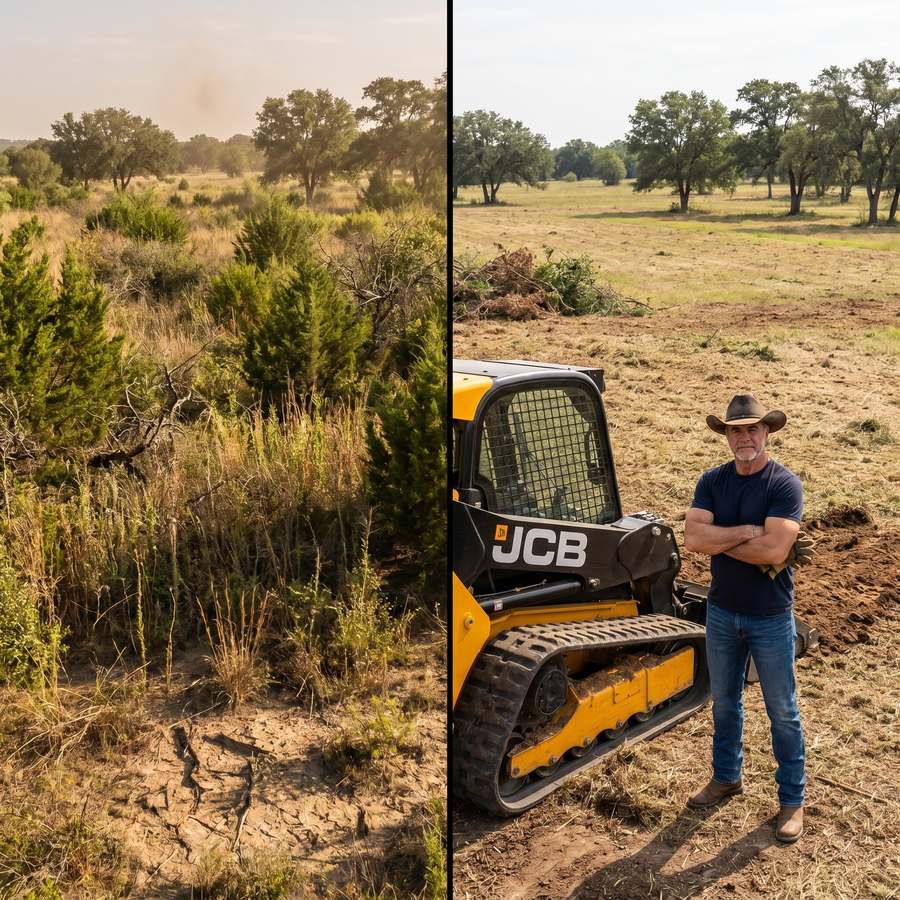
Forestry mulching in Texas typically runs $1,500–$6,000 per acre. The biggest driver isn't acreage — it's vegetation density and tree size, then terrain and project scale. Light brush sits at the low end; dense cedar or heavy tree cover at the high end. Every job is quoted as a whole after a site visit, and a minimum job price applies.
Land clearing quotes in Texas can feel like a mystery. Two properties of similar size can come back with wildly different numbers, and without context it's hard to know if a quote is fair or inflated. This guide breaks down what actually drives forestry mulching cost per acre in Central Texas — with real ranges, worked examples by acreage, and the local factors most out-of-state pricing guides completely miss.
Key takeaways
- Texas forestry mulching runs about $1,500–$6,000 per acre, driven mainly by how thick the vegetation is and how big the trees are.
- Bigger jobs cost less per acre — mobilization gets spread across more ground.
- Central Texas has its own cost drivers most guides ignore: dense cedar, caliche and rock, Hill Country slopes, and mesquite roots.
- Mulching typically runs 20–40% cheaper than traditional clearing — no hauling, burning, or disposal.
- Per-acre figures are a planning guide only. Every machine job is quoted as a whole after a free on-site walk, and a minimum job price applies.
Texas Forestry Mulching Runs $1,500–$6,000 Per Acre
The standard range for forestry mulching in Texas lands between $1,500 and $6,000 per acre. That's a wide window, but it reflects real variation in vegetation and terrain — not arbitrary pricing. Here's how it breaks down by what's growing:
| Vegetation type | Typical cost / acre |
|---|---|
| Light brush (grass, weeds, saplings under 3") | $1,500–$2,500 |
| Medium (mixed brush, trees 3–6") | $2,500–$4,000 |
| Heavy brush (dense, trees 6–10") | $4,000–$6,000 |
| Mature timber (10"+, requires separate felling) | $6,000–$10,000+ |
These are ballpark market ranges — the actual number for your property depends on the specifics below, which is why every job is priced after an on-site look.
How Much Does It Cost to Clear 1, 5, 10, or 20 Acres in Texas?
This is the question most landowners are really asking. Because bigger projects spread the fixed cost of hauling equipment out to the site across more ground, the per-acre rate drops as acreage goes up. Here's the pattern:
| Project size | Typical per-acre rate | Ballpark total (medium brush) |
|---|---|---|
| Under 1 acre | $2,500–$4,000 | subject to minimum job price |
| 1 acre | $2,500–$4,000 | ~$2,500–$4,000 |
| 5 acres | $2,000–$3,500 | ~$10,000–$17,500 |
| 10 acres | $1,800–$3,000 | ~$18,000–$30,000 |
| 20+ acres | $1,200–$2,500 | ~$24,000–$50,000 |
A practical example: a 2-acre lot of medium brush at $3,000/acre totals about $6,000. That same land type at 20 acres might average $2,000/acre — real money saved per acre just from scale. Light brush comes in lower; dense cedar or heavy tree cover pushes higher. On very small jobs, the minimum job price — not the per-acre rate — sets the floor.
What Drives the Price Up or Down
Vegetation Density and Tree Size
A mulcher can power through light brush at 3–5 acres a day. Dense cedar or mesquite with established roots can slow that same machine to under an acre in a full day — and more machine time means more cost. Tree diameter matters just as much: mulching is efficient up to roughly 8–10 inches; anything bigger needs to be felled separately first, adding labor.
Terrain and Access
Flat, open, easy-to-reach ground is cheapest. Steep or rocky ground slows the machine and can add 10–40% to the rate. Remote properties also carry a mobilization cost to haul equipment in and out — which is exactly why bigger jobs price better per acre.
Texas-Specific Cost Factors Most Guides Miss
The pricing pages that rank for this search are usually written for other states. Here's what actually moves the number in Central Texas:
- Cedar (Ashe juniper) density. Dense cedar is slow, hard work — it's the single biggest thing that pushes a Central Texas job toward the high end.
- Caliche and rock. Shallow limestone and caliche are everywhere on the Edwards Plateau. Rock near the surface wears equipment and slows progress, and it can rule out some ground-level work entirely.
- Hill Country slopes. Sloped and canyon ground is slower and more demanding to work safely, which raises the rate.
- Mesquite root systems. Mesquite resprouts aggressively from the root, so lasting results sometimes need more than a single mulching pass.
- Protected habitat. Mature juniper-oak woodland in this region can be habitat for a federally protected species, which may require assessment before clearing. That's a legal and scheduling factor, not just a cost one — always worth checking before you cut old-growth cedar-and-oak stands.
Cost Breakdown by Vegetation Type
- Cedar (Ashe juniper): the most common target across Central Texas. Dense stands under 8" usually fall in the $2,500–$5,000/acre range. Cedar mulch also helps suppress regrowth.
- Mesquite: thorny and deep-rooted; lasting clearing sometimes pairs mulching with grubbing. Medium-to-heavy pricing depending on density.
- Light mixed brush / pasture reclamation: overgrown pasture with scattered saplings — the most budget-friendly, typically $1,500–$2,500/acre.
- Mature hardwoods: anything consistently over 10" pushes toward the top of the range and may need felling first.
Forestry Mulching vs. Traditional Clearing
Forestry mulching is a single-machine, single-pass operation — it cuts, grinds, and spreads all at once. Traditional clearing needs a chain of equipment plus hauling and burning. That's where the 20–40% savings come from: no debris removal fees, no burn permits, no hauling. It's the cost-effective choice when trees are under about 10–12 inches and you don't need every root grubbed out. Traditional clearing still wins when there's marketable timber to sell or the site needs deep excavation anyway.
Why Two Similar Properties Get Very Different Quotes
Two 5-acre parcels in the same county can price thousands apart — one is light brush on flat ground, the other is dense cedar on a rocky slope. That's not inconsistent pricing; it's the work being genuinely different. It's also why no honest contractor can give you a firm price sight-unseen. A photo or satellite view gets you a ballpark; the real number comes from walking it.
How CHEW prices it: we serve a 70-mile radius around Coryell County, and every job is quoted as a whole after a free on-site walk. Per-acre figures are a planning guide, not a binding number, and a minimum job price applies — because the per-acre math only holds once someone has actually seen the density, tree size, rock, and access. Text photos to 737-235-1335 for a rough range before we drive out.
Frequently Asked Questions
How much does it cost to clear an acre of cedar in Texas?
Dense Ashe juniper typically runs about $2,500–$5,000 per acre depending on how thick it is and the terrain. Lighter cedar comes in lower; a rocky slope pushes higher. It's quoted after a site visit, and a minimum job price applies.
Is forestry mulching cheaper than a bulldozer or excavator?
For most brush and trees under ~10–12 inches, yes — usually 20–40% cheaper, because there's no hauling, burning, or disposal, and it's one machine instead of several. Traditional clearing only wins on marketable timber or jobs that need deep excavation.
Do you charge by the acre or by the hour?
By the job, as a fixed written price you approve before we start — so you're never watching a meter. Per-acre figures are just a planning guide to get you in the ballpark.
How much does it cost to clear 10 acres?
Ballpark, medium brush at ~$1,800–$3,000/acre lands around $18,000–$30,000 — but density and terrain move that a lot, and larger acreage earns a lower per-acre rate. We quote the whole job after seeing it.
Why is my quote higher than the online per-acre range?
Usually density, tree size, rock, slope, or access — or a small job hitting the minimum price. The online ranges are averages; your property is specific, which is the whole reason we walk it before quoting.