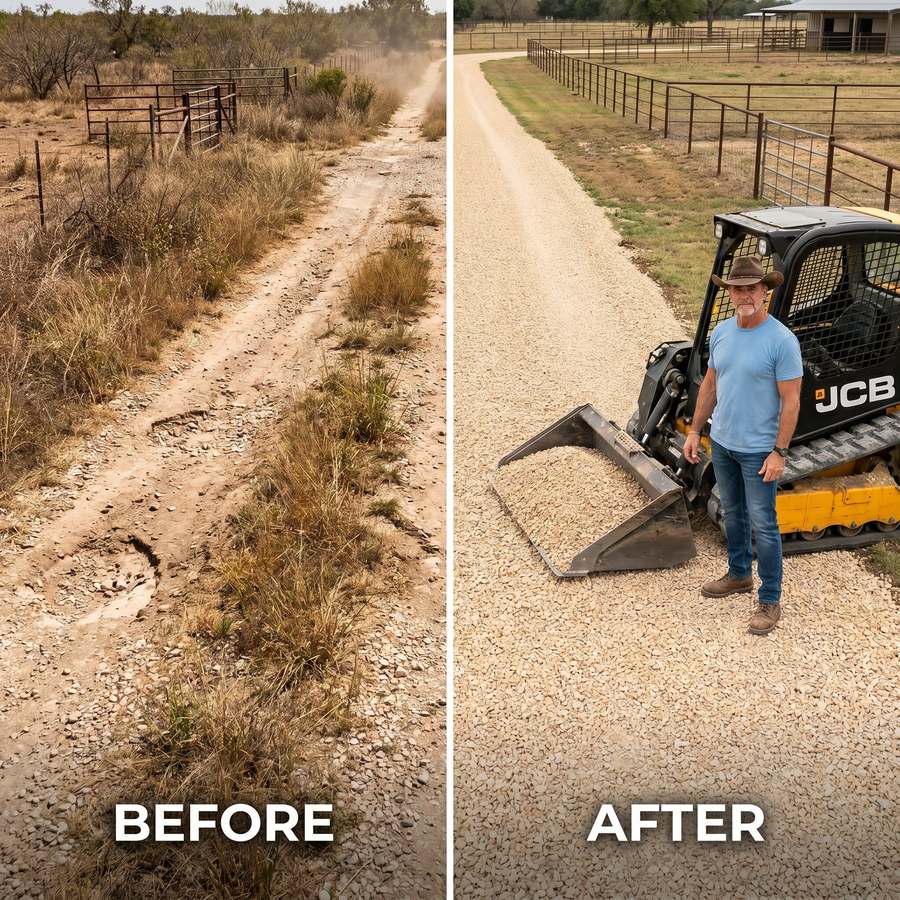
Repairing a gravel driveway means fixing its shape and drainage, not just adding rock. A lasting repair regrades the surface, rebuilds the crown so water sheds to the sides, adds crushed base material, and compacts it firm. In Central Texas, CHEW quotes each driveway after a free on-site look.
If your driveway beats up your truck every time you pull in, you already know the problem. Ruts deep enough to grab a tire, potholes that fill with water after every storm, gravel that's washed clear down to the dirt. Around here it happens fast — our clay soil doesn't drain, and one hard Central Texas rain can cut a channel right down the middle of a driveway that looked fine a month ago.
Here's the part most folks don't hear until it's too late: dumping a fresh load of gravel on top of a bad driveway is money thrown away. If the base is wrong and the water has nowhere to go, that new rock disappears into the mud or washes off by spring. A driveway that lasts isn't about how much gravel you pile on — it's about shape and drainage. Let me walk you through how it's actually done.
Why gravel driveways fail out here
Nearly every worn-out driveway we see comes down to one thing: water sat where it should have run off. A driveway is supposed to shed rain to the sides. When it goes flat — or worse, dishes in the middle — water pools, softens the base, and traffic pumps the mud up through the rock. From there it's a fast slide to ruts and potholes.
- No crown. The surface needs a slight peak down the center so water rolls off. Most failed driveways have lost theirs.
- No drainage path. If the sides are bermed up with old gravel and grass, water is trapped on the driveway with nowhere to escape.
- Wrong material. Loose round rock with no fines never locks together. It just rolls and scatters.
- Never compacted. Gravel that isn't packed stays loose, shifts under tires, and washes easily.
How a driveway is actually repaired
A real repair fixes the shape and the drainage — not just the surface. Here's the order of operations.
1. Reclaim what's already there
A lot of driveways don't need much new gravel at all. Years of rock have usually been pushed into the shoulders and ruts. We regrade and pull that material back into the driving surface first. On a lot of jobs that alone saves the customer real money, because we're not hauling in tons of new stone we didn't need.
2. Fix the base and the shape
We cut down the high spots, fill the low spots, and rebuild the crown so the whole surface sheds water to the sides. If there's a soft, muddy section, that gets addressed before anything goes on top — otherwise the new rock just sinks into the same wet spot.
3. Add the right material — crusher run, not loose rock
For a driveway that holds, you want a crushed base material with fines in it — around here that's commonly called crusher run or road base. The fines pack down and lock the stone together into a hard surface, instead of loose gravel that rolls under your tires. A clean topping stone can go over that for looks, but the base is what carries the weight.
4. Crown it and compact it
This is the step that separates a driveway that lasts from one you're fixing again next year. We shape a proper crown, then compact the surface so it sets up firm and sheds water instead of soaking it up. Compaction is not optional — skip it and you've just built next season's potholes.
Water is what destroys a driveway. Get the crown and the drainage right, compact it, and you've solved 90% of the problem — no matter how much gravel is on top.
Repair or full rebuild?
Not sure which you need? A rough guide:
- Regrade / repair — the driveway is basically there but rutted, potholed, or flattened out. Often the fix is reshaping existing material plus a little new rock.
- Base rebuild — the rock is gone, the base is soft, or water has cut deep channels. This needs new material and a rebuilt crown.
- New install — bare dirt two-track, a new building site, or a fresh access road with no base at all.
We'll tell you straight which one your driveway needs when we look at it. If a regrade will hold, we're not going to sell you a full rebuild.
How CHEW prices driveway work
Every driveway is quoted as a whole after we see it — length, width, how bad the base is, drainage, and how much new material it actually needs all factor in. We give you a written price before any work starts, so there's no meter running and no surprise on invoice day. On material, we arrange the delivery and handle all the spreading, grading, and compaction with our equipment — you don't have to coordinate a thing.
One more note for our neighbors on acreage: if you've got a long ranch drive or an access road that washes out every year, a maintenance regrade on a schedule is a lot cheaper than letting it fall apart and rebuilding it. Ask about that when we're out.