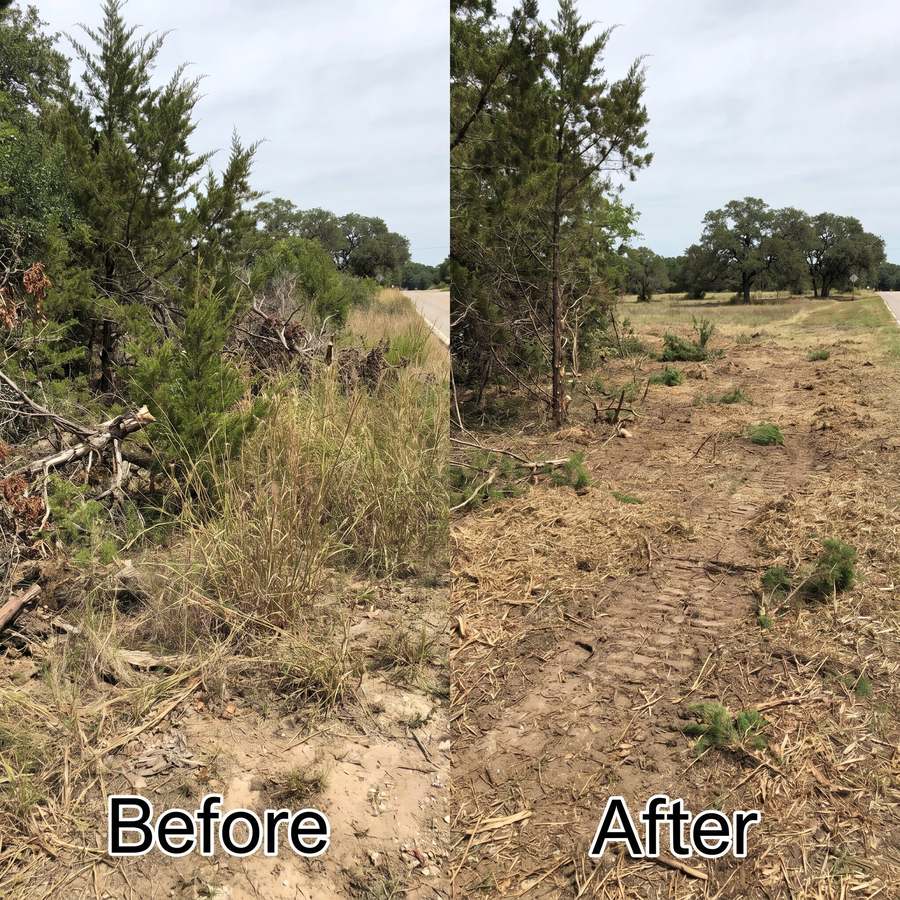
Yes — forestry mulching cuts wildfire risk by removing “ladder fuels,” the brush and small trees that carry a ground fire up into the canopy. Grinding that vegetation into a mulch layer in one pass creates defensible space and slows fire spread — critical on Central Texas's drought-prone land.
Central Texas landowners face year-round wildfire threats, but most don't realize the biggest danger isn't the trees themselves. It's the invisible "ladder fuels" hiding beneath them. Here's why forestry mulching targets exactly what fire needs to explode from ground level into an unstoppable crown fire.
Key takeaways
- Central Texas ranks among the highest wildfire-risk regions in the nation — driven by drought, heat, and growth along the wildland-urban interface (WUI).
- Forestry mulching removes ladder fuels — the brush and small trees that carry ground fires into the treetops — in a single machine pass.
- The mulch layer left behind improves soil health, controls erosion, and supports native plant recovery.
- It's one of the most efficient fuel-reduction strategies available, and it works with the land instead of tearing it up.
Wildfire is no longer a distant concern for Central Texas landowners. It's a present-tense reality, and the window to act tightens every year. Forestry mulching — sometimes called tree mulching — has emerged as the most practical first move for property owners who want meaningful risk reduction without tearing up the land they're trying to protect.
Texas Carries One of the Nation's Highest Wildfire Burdens
Central Texas sits squarely in the danger zone: prolonged drought cycles, intense summer heat, dense stands of cedar and dry brush, and a wildland-urban interface that grows wider every year as the region's population expands.
Roughly 85% of Texas wildfires originate in the WUI — the zone where neighborhoods push up against wildland vegetation. The Parmer Lane Fire in Cedar Park on August 8, 2023, showed how quickly a fire can move through that interface. The neighborhoods that fared best had one thing in common: fire-resistant construction and reduced vegetation loads around structures. About 90% of Texas wildfires are human-caused, which means preparedness — not luck — is the primary variable landowners can control.
That shift from a seasonal threat to a persistent, year-round one has changed how land managers think about fuel reduction. CHEW works with Central Texas property owners to address exactly this challenge through targeted forestry mulching designed to cut fuel loads before fire finds them.
What Forestry Mulching Actually Does to Vegetation
Forestry mulching uses a single specialized machine — a forestry mulcher — to cut, grind, and clear vegetation on-site, leaving a uniform layer of wood-chip mulch across the ground. No hauling, no burning, no second pass with a different machine.
One Machine, One Pass
Traditional clearing often requires a sequence of equipment: a cutter, a skidder, a chipper, a haul truck. Forestry mulching collapses that into one operation. The mulching head processes trees, brush, and stumps simultaneously, leaving the site cleared and the mulch layer in place — ready to work for the soil rather than sitting in a landfill.
Ladder Fuels: The Hidden Fire Accelerant
"Ladder fuels" are vegetation that gives a ground fire a physical path to climb into the canopy. The progression is straightforward: dry grass ignites, flames reach knee-high brush, brush ignites lower tree limbs, and a manageable ground fire becomes an unstoppable crown fire. Cedar, juniper, and invasive underbrush are the primary ladder-fuel offenders in Central Texas. Forestry mulching targets this vegetation layer specifically — eliminating the rungs of the ladder before fire can use them.
How Mulching Cuts Wildfire Fuel at the Source
Less combustible material means less fire intensity and slower spread. Forestry mulching attacks fuel at two critical points in a fire's growth cycle.
Eliminating Ladder Fuels
By grinding down underbrush, small trees, and downed limbs, mulching removes the connective tissue between ground-level fire and the upper canopy. Wood-chip mulch is among the more fire-resistant organic mulch types — while all organic material is combustible, wood chips tend to burn more slowly than dry brush and loose debris, which can meaningfully reduce fire spread across a cleared area. For the immediate zone around any structure, inorganic materials remain the recommended choice.
Stopping Crown Fires Before They Start
Crown fires — the type that generate their own wind and can outrun emergency vehicles — are born from dense, connected canopy fueled from below. Removing ladder fuels and thinning vegetation interrupts that ignition pathway. For properties with mature live oak or pecan canopies worth preserving, this matters: the goal is strategic fuel-load reduction, not clear-cutting, so those trees aren't turned into torches.
Building Defensible Space Around Your Property
Defensible space is the buffer between a structure and the surrounding wildland vegetation. It's where firefighters make their stand, and where a home either survives or doesn't.
Texas A&M Forest Service Guidelines
The Texas A&M Forest Service supports a layered approach to defensible space — vegetation management, selective tree pruning, and fuel breaks that slow fire spread and give responders room to work. Accepted practice segments the area around a structure into distance-based zones, with more vegetation permitted as distance from the structure grows. Forestry mulching is well suited to establishing and maintaining those outer zones — clearing dense brush efficiently without disturbing the soil structure that holds slopes together.
The Immediate Zone: Where Non-Combustible Materials Are Required
Within five feet of any building, organic mulch is not the right tool. For this innermost zone, fire-safety guidelines specify inorganic materials — decomposed granite, gravel, or rock — that don't ignite. Forestry mulching serves the broader property; the immediate structure zone requires a different solution.
Environmental Gains Beyond Fire Prevention
Erosion Control in Heavy Rain Country
Central Texas is defined by extremes: prolonged dry spells punctuated by intense rainfall. Bare, disturbed soil is highly vulnerable to washout during those events. The mulch layer stabilizes the soil surface, slows runoff, and retains moisture — directly reducing erosion on slopes and creek-adjacent properties. In Hill Country terrain, where thin topsoil can disappear fast after a clearing operation that leaves ground exposed, that protection matters.
Soil Health and Native Plant Recovery
As the mulch decomposes, it releases organic nutrients back into the soil, improving fertility and supporting root systems. For Central Texas specifically, it helps suppress invasive Ashe juniper (cedar), which crowds out native grasses and forbs that are both fire-resistant and ecologically valuable. Native plant communities, once given room to reestablish, reduce fuel loads naturally over time and provide wildlife habitat. Mulching sets the conditions for the land to manage itself better going forward.
Forestry Mulching vs. Traditional Clearing Methods
- Bulldozing removes all vegetation but strips topsoil, destroys soil structure, and leaves a barren surface prone to erosion and invasive re-colonization.
- Burn piles are the most common ignition source for accidental wildfires in Texas — a counterproductive strategy in a high-risk area that also releases carbon and provides no soil benefit.
- Hauling and chipping off-site requires multiple machines and labor, adds transport costs, and removes the organic material that could improve on-site soil.
- Forestry mulching combines clearing, chipping, and dispersal in one pass. Soil structure is preserved, organic matter stays on-site, and the cleared area is stable.
For Central Texas, where rocky, shallow soils make bulldozing especially damaging, preserving soil integrity is a meaningful long-term advantage.
What It Costs — and What It Saves
Forestry mulching for wildfire fuel reduction generally runs in the light-to-medium vegetation range, with cost varying by density, terrain, and site access. It's competitive against multi-step clearing that requires separate equipment for each phase — the consolidated process reduces labor hours and eliminates haul-away fees.
The less visible savings are structural. Properties with established defensible space are less likely to sustain damage in a wildfire — a lesson reinforced by the Parmer Lane Fire, where fire-resistant construction and reduced vegetation loads made a measurable difference. Insurance, property value, and the cost of post-fire remediation all factor into a return that goes well beyond the per-acre clearing price.
How CHEW prices it: we serve a 70-mile radius around Coryell County, and every job is quoted as a whole after an on-site visit. Per-acre figures are a planning guide, not a binding number, and a minimum job price applies. We'll walk your property, map the fuel loads that matter most, and tell you straight what it needs.
A Cost-Effective First Step Toward Real Risk Reduction
No single action eliminates wildfire risk, but forestry mulching addresses the most controllable variable: fuel load. By removing ladder fuels, reducing vegetation density, and creating defensible space in one efficient operation, it gives Central Texas landowners a credible, documented step toward protecting both property and the surrounding landscape. The mulch layer that remains is a long-term asset — holding soil through heavy rain, feeding native plants, and keeping the ground covered while fire-resilient vegetation establishes itself.